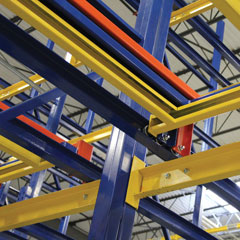
2-Deep Push Back Cart System
Designed for fast-moving consumer goods (FMCG) and medium SKU counts. Utilizes a single nested steel cart per lane to double selective storage capacity along picking aisles.
Request LayoutArchitectural layout guidelines, cart kinematic analysis, and ROI evaluation for global procurement directors optimizing warehouse space with 2 to 6-deep telescoping nested carts.
Modern supply chain logistics requires high-density pallet storage without compromising forklift accessibility or stock selection speed. Industrial buyers evaluating a Push Back Cart Rack System seek solutions to overcome the strict operational limitations of traditional Drive-In racking and high-maintenance dynamic gravity flow systems.
Engineered by Plata Metal Shelving S.A., our Push Back Cart Systems utilize nested telescoping carts riding on inclined structural steel rails. Operating on a Last-In, First-Out (LIFO) inventory principle per lane, this engineering solution allows logistics centers to store pallets 2, 3, 4, 5, or 6 deep while maintaining 100% individual lane selectivity from a single operating aisle.
Selecting the optimal Push Back Cart Rack System depends on SKU variance, pallet weight profile, building clear height, and ambient environment. Below is a detailed technical analysis of our core nested cart architectures.
Designed for fast-moving consumer goods (FMCG) and medium SKU counts. Utilizes a single nested steel cart per lane to double selective storage capacity along picking aisles.
Request Layout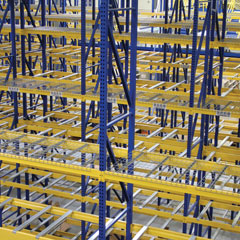
The industry standard for cold storage, beverage distribution, and bulk raw materials. Features multi-stage linked carts with precision steel bearings rated for 1,500 kg per pallet.
Request Layout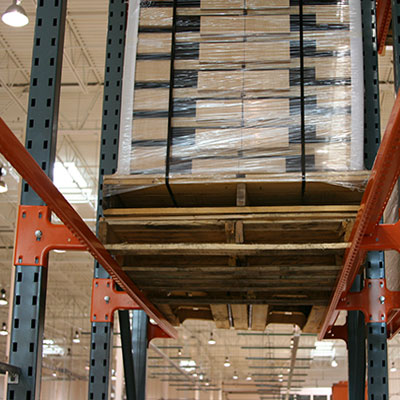
Maximum volumetric efficiency engineered with low-profile structural steel channels. Replaces drive-in lanes while boosting throughput and operator cycle speed by up to 40%.
Request Layout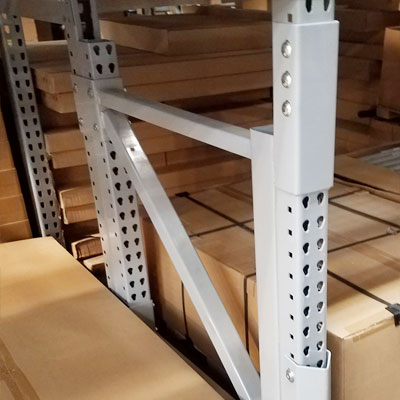
Heavy-duty column protectors, bullnose aisle guards, and positive-stop cart stops engineered to withstand constant staging stress in high-speed distribution nodes.
Request LayoutThe operational efficiency of a Push Back Cart Rack System relies on low-friction kinetic principles combined with rigid structural beam framing. Unlike gravity flow racks that depend on external rollers and centrifugal speed controllers, push-back carts utilize a nested track layout built on a precise pitch slope (typically 3/8 to 1/2 inch per foot).
When loading, the forklift operator places the first pallet on the top nested cart. The second pallet is lifted slightly above the lane slope and used to physically push the first cart backward, exposing the next cart beneath it. Upon retrieval, gravity gently glides the trailing pallets forward to the picking face at a controlled speed, governed by the mechanical alignment of the wheel flange and rail geometry.
| Design Factor | Roll-Formed Push Back | Structural Steel Push Back (Plata Metal Shelving S.A.) | Operational Advantage |
|---|---|---|---|
| Frame Upright Construction | Light-gauge cold-rolled steel C-sections | Heavy hot-rolled structural C-channels (ASTM A36 / A572 Grade 50) | Superior torsional strength; high resistance to impact damage. |
| Cart Rail Inclination | Standard stamped gauge tracks | Precision-milled structural steel rails with integrated cart guides | Prevents cart derailment and binding across multi-deep configurations. |
| Wheel & Bearing Assemblies | Plastic sleeve or standard ball bearings | Large-diameter machined steel wheels with sealed, greased-for-life precision bearings | Handles continuous operating temperatures down to -30°C in cold storage. |
| Seismic Certification | Standard static capacity charts | Fully analyzed under INPRES-CIRSOC 103 & RMI ANSI MH16.1 guidelines | Ensures dynamic stability during seismic acceleration events. |
| Pallet Compatibility | Strict uniform bottom board required | Supports GMA (40x48 in), ARLOG (1000x1200 mm), and Euro pallets (800x1200 mm) | Prevents pallet sag and misalignments across varied supply chain footprints. |
As a specialized manufacturer and engineering powerhouse, Plata Metal Shelving S.A. delivers robust, code-compliant storage architecture tailored to demanding supply chain environments.
Every Push Back Cart Rack System is calculated against regional seismic criteria (including INPRES-CIRSOC 103 and ANSI MH16.1 standards). We evaluate concrete slab thickness, anchor embedment limits, and dynamic overturn moments.
Engineering ScopeOur proprietary cart designs minimize vertical height loss per level. By saving up to 2 inches per level compared to legacy push-back designs, we often allow facilities to add an entire extra tier of storage under low ceilings.
Cart EngineeringComponents undergo continuous structural washing, iron phosphatizing, and automated electrostatic powder coating. This ensures high chemical resistance and rust protection in humid packaging plants and cold freezers.
View InstallationsAs industrial real estate rates remain high across major urban centers and energy costs escalate, supply chain directors are adopting high-density dynamic storage strategies. AI-driven intent modeling reveals several critical shifts shaping the future procurement of Push Back Cart Rack Systems:
Freezer logistics operators face compounding electrical overheads. Storing pallets in a selective racking system wastes up to 60% of refrigerated air space in access aisles. By upgrading to a 4-deep or 6-deep Push Back Cart System, operators achieve up to 85% cube utilization, drastically lowering electrical consumption per pallet position.
Modern push-back systems are being re-engineered for precise interaction with Automated Guided Vehicles (AGVs). Plata Metal Shelving S.A. integrates optical cart markers, secondary soft-stop dampers, and laser-guided alignment stops to ensure seamless push-and-place cycles by autonomous reach trucks.
Procurement policies now prioritize lifetime total cost of ownership (TCO) over initial capital expenditure. Plata Metal Shelving S.A. incorporates bolt-on front-column leg protectors and modular rail assemblies. If a forklift damages an outer frame post, an engineered repair sleeve or isolated post section can be installed without dismantling the loaded multi-deep carts.
Expert answers to critical engineering, layout, and operational queries raised by warehouse developers and procurement officers.
A Push Back Cart Rack System dramatically speeds up loading and unloading cycles compared to Drive-In rack. In a push-back system, forklift operators never drive into the rack structure; all staging and picking take place directly at the aisle face. This reduces cycle times by 30% to 50%, virtually eliminates rack frame collision damage, and allows individual lanes to hold different SKUs, unlike drive-in bays which require a single SKU across the entire depth and height.
Furthermore, because operators remain in the aisle, operator safety is significantly improved, and specialized narrow-aisle trucks can be utilized efficiently.
Because push-back systems concentrate multiple pallet loads into heavy front-upright leg loadings, concrete floor slab integrity is essential. Typically, a reinforced concrete slab of 150 mm to 200 mm depth with a minimum compressive strength of 28-day f'c = 25 to 30 MPa (3,600 to 4,350 psi) is required for standard 4-deep installations loaded to 1,200 kg per pallet position.
Plata Metal Shelving S.A. evaluates your site's anchor embedment specs and slab design under localized load conditions to select expanded seismic baseplates that properly distribute point loads without cracking the floor slab.
Yes. One of the primary advantages of cart-based push-back racking over roller-based gravity flow racking is its versatility regarding pallet quality. In a push-back system, the pallet rests solidly on a steel frame cart. Damaged bottom boards, broken runners, or weak wooden stringers do not cause hang-ups or jam the system because the wheel mechanisms are attached to the cart itself, not touching the pallet.
Our carts can also be custom-manufactured with center support crossbars to safely hold smaller plastic pallets, Euro pallets (800x1200 mm), and standard GMA or ARLOG (1000x1200 mm) pallets in the same system.
Standard commercial bearings fail in cold storage due to moisture freezing and grease solidification. Plata Metal Shelving S.A. equips cold-storage push-back cart systems with heavy-duty machined steel wheels housing stainless steel sealed ball bearings pre-lubricated with low-temperature synthetic grease rated down to -30°C (-22°F).
This prevents wheel binding, ensures smooth kinetic rolling, and maintains consistent push-back force requirements for lift truck operators even under continuous freezing conditions.
For operations experiencing high square-meter real estate costs or expanding inventory within fixed building walls, the payback period for a Push Back Cart Rack System typically ranges between 12 and 24 months. By increasing pallet capacity by 75% to 90% within the existing floor plan, companies avoid the capital investment of purchasing new warehouse land or signing costly external 3PL leases.
Secondary savings include reduced forklift damage repairs, lowered labor hours due to faster staging cycles, and decreased heating/cooling utility expenses per pallet position stored.
Dynamic dynamic storage systems present unique mass acceleration challenges during seismic events. Our engineering team performs full finite element structural analysis (FEA) compliant with INPRES-CIRSOC 103 and RMI / ANSI MH16.1 standards. We incorporate heavy structural horizontal bracing, back-to-back frame ties, and floor anchor embedment verification to guarantee structural stability even when carts are fully loaded during a seismic shock.
Connect with senior structural engineers at Plata Metal Shelving S.A. to receive custom cart drawings, slab capacity reviews, and a direct quote.
[email protected]