Engineered Industrial Racking & Storage Portfolio
Verified Structural Specifications for Warehouses, Logistics Hubs, and Manufacturing Plants
Executive Technical Summary: Defining Engineering Standards in Heavy-Duty Industrial Racking
In modern supply chain management and industrial logistics, the structural design, steel grade integrity, and seismic tolerance of industrial shelf racks dictate operational throughput and long-term facility safety. As a top trusted supplier and exporter, our engineering philosophy aligns with international standards including ANSI MH16.1 (Specification for the Design, Testing and Utilization of Industrial Steel Storage Racks), RMI (Rack Manufacturers Institute) specifications, and regional seismic codes such as INPRES-CIRSOC 103.
Selecting an optimal storage matrix requires more than simply choosing beam dimensions. It demands an end-to-end structural audit evaluating concrete slab compressive strength, forklift mast height tolerances, pallet dimensions (e.g., ARLOG 1000×1200 mm, Euro 1200×800 mm, and standard 40×48-inch pallets), and precise SKU rotation velocity. Whether configuring roll-formed teardrop configurations or structural steel bolted frames, our manufacturing facilities execute rigorous tensile testing on Q235B and Q355B cold-rolled structural steel to ensure ultimate load reliability under dynamic working conditions.
Structural Steel Integrity
Utilizing high-yield Q355B hot-rolled steel channels and structural C-sections engineered for extreme impact loads, heavy machinery storage, and high-bay installations exceeding 12 meters.
Roll-Formed Versatility
Precision-engineered teardrop and slotted beam connections utilizing high-strength Q235B cold-rolled steel, offering rapid level adjustability in 50mm or 75mm increments for evolving e-commerce inventories.
Seismic Resilience Engineering
Integrated FEA (Finite Element Analysis) structural modeling ensuring column baseplate anchor calculations and upright bracing patterns withstand dynamic lateral forces in high-hazard seismic zones.
Engineering Deep-Dive: Comprehensive Industrial Storage System Recommendations
Industrial storage solutions must be customized to fit structural parameters, forklift operational parameters, and inventory handling methodologies. Below is an engineering analysis of primary industrial shelf rack architectures designed and manufactured across our export facilities.
| Racking System Architecture | Storage Density | Pallet Selectivity | Inventory Handling | Ideal Industrial Application |
|---|---|---|---|---|
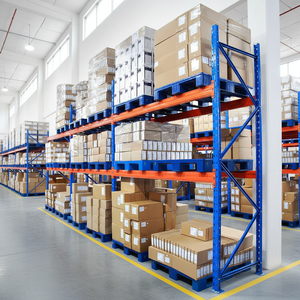
| Selective Pallet Racking | Standard (30-40% Cube Use) | 100% Direct Access | FIFO / LIFO | 3PL Warehouses, FMCG Distribution, Mixed-SKU Facilities |
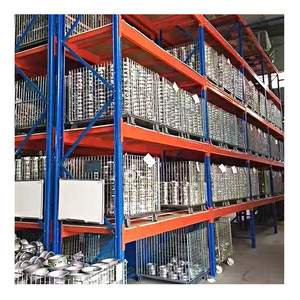
| Heavy-Duty Multi-Tier Shelving | High (Vertical Multi-Level) | 100% Manual Access | FIFO Pick Modules | E-commerce Fulfilment, Spare Parts, Automotive Components |
| Push-Back Cart Systems | High (2 to 6 Pallets Deep) | Lane-Selective | LIFO | Cold Storage, Beverage Bottling, Medium-SKU High-Volume |
| Pallet Gravity Flow Racking | Very High (Up to 20 Deep) | Lane-Selective | Strict FIFO | Perishable Foods, Pharmaceuticals, High-Throughput DCs |
| Drive-In / Drive-Thru Racking | Ultra-High (up to 85% Cube Use) | Low (Per Lane) | LIFO / FIFO | Seasonal Agro-Storage, Bulk Chemical, Cold Rooms |
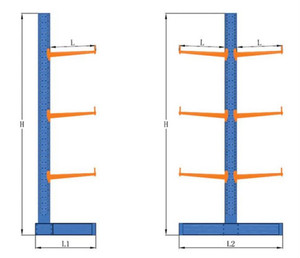
| Heavy-Duty Cantilever Racking | Variable / Open-Front | 100% Long-Load Access | Free-Length Access | Lumber Yards, Steel Pipes, Extrusions, Energy Tubing |
| AS/RS High-Bay Structures | Maximum (15m to 40m Height) | 100% Automated Access | Automated System Controlled | Fully Automated Smart Warehouses & High-Density Hubs |
1. Selective Pallet Racking Systems
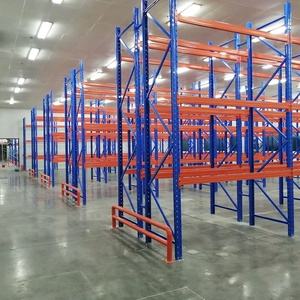
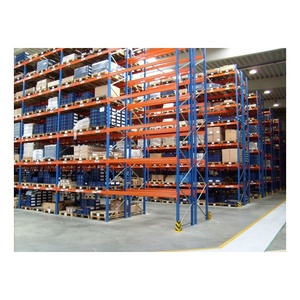
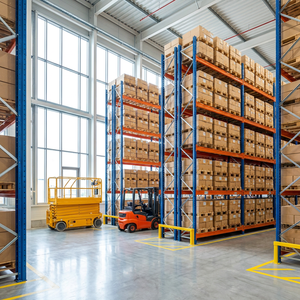
The standard benchmark for logistics centers. Direct 100% pallet accessibility allows immediate stock rotation without moving adjacent pallets. Beam load capacities range from 1,000 kg to 4,500 kg per pair, configured with dual safety pins to prevent accidental forklift beam displacement.
2. Multi-Tier Heavy Duty Steel Shelving
Engineered for high-density small-parts pick modules. Incorporates steel decking, mesh flooring, and integrated staircases. Maximizes vertical height in high-ceiling facilities, multiplying usable floor area by 200% to 300% without structural building expansion.
3. High-Density Drive-In & Push-Back Racks
Eliminates operating aisles by allowing forklifts to drive directly into storage bays or utilizing nested rolling carts on sloped steel rails. Reduces required floor space by up to 75% for uniform product lines and cold-storage operations.
4. Heavy-Duty Cantilever Racks
Specifically manufactured for non-standard, linear materials such as steel pipes, timber, PVC conduit, and aluminum extrusions. Available in single-sided and double-sided column configurations with bolted adjustable arms featuring capacity up to 3,000 kg per arm.
5. Automated Storage & Retrieval Systems (AS/RS)
Precision-manufactured rack structures tolerance-engineered for stacker cranes and Shuttle AMRs. Fabricated with tight deflection ratios (L/240 or tighter) to support high-speed robotic insertion and extraction up to 40 meters in height.
6. Specialized SMT & Industrial Trolley Racks
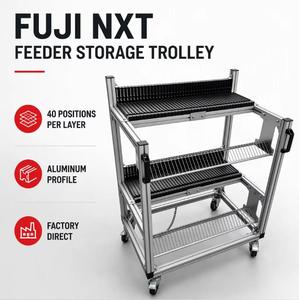
Designed for high-tech electronics manufacturing plants (e.g., FUJI NXT SMT feeder carts). Features ESD-safe anti-static conductive coatings, heavy-duty caster assemblies, and precision stainless steel slots for sensitive component feeding.
Macro Procurement Trends: What Global Supply Chain Directors Must Plan For
Procurement of industrial shelf racks has evolved from a standard hardware purchase into a strategic capital investment focused on automation integration, supply chain resilience, and lifecycle total cost of ownership (TCO). Procurement teams must evaluate key trends shaping industrial warehouse equipment over the coming decade:
1. Transition to Ultra-Tall & VNA Architectures
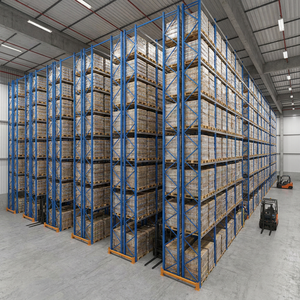
As industrial land costs escalate near urban centers and logistics gateways, facilities are expanding vertically. Very Narrow Aisle (VNA) systems operating at 15+ meters with wire-guided turret trucks require precision rack verticality tolerances (<1/1000 plumbness) and high-strength baseplate anchor calculations.
2. Extreme Cold-Chain Structural Resilience
Global demand for fresh food, frozen protein export, and bio-pharmaceutical storage is driving cold-storage racking growth. Racks operating in -30°C environments require specialized low-temperature carbon steel grades treated to prevent cold brittleness and micro-cracking, paired with hot-dip galvanized or thermosetting epoxy powder finishes.
3. Stringent Seismic Risk Compliance
Multinational logistics operators require unified global safety standards. Racking installed in earthquake-prone regions must comply with strict dynamic load testing, heavy-duty floor anchor embedments, and seismic frame cross-bracing designed to withstand major lateral displacement without catastrophic collapse.
4. AMR & Robotic Automation Compatibility
Traditional racking is increasingly retrofitted with guide rails, rack-mounted charging docks, and sensor reflectors to support Autonomous Mobile Robots (AMRs) and automated pallet shuttles. Floor levelness and exact rack entry clearance are now vital procurement criteria.
Technical Development Trends in Industrial Storage Manufacturing
The manufacturing process for industrial racking has underwent significant metallurgical and technological upgrades. Leading exporters utilize state-of-the-art automated production lines to deliver superior finish quality, higher yield strength ratios, and extended service lifespans.
Automated Continuous Cold-Roll Forming
Multi-stage cold roll-forming mills shape continuous steel coil into complex multi-flange upright profiles. This cold-working process increases structural yield strength by up to 15% without adding dead weight, maximizing dynamic load capacity.
Robotic Laser Punching & Welding
Automated CNC laser punching systems ensure millimeter-exact connector hole pitch across 12-meter upright lengths. Robotic welding arms execute continuous, seam-sealed penetration welds on beam connector claws, eliminating structural weak points and fatigue fractures.
Multi-Stage Electrostatic Powder Surface Treatment
To resist industrial impact, abrasion, and atmospheric humidity, components undergo an 8-stage pre-treatment wash (degreasing, phosphating, and deionized water rinse) followed by automated electrostatic epoxy-polyester powder coating cured at 200°C. Coating thickness averages 60 to 80 microns for superior scratch and rust resistance.
Engineered Modular Rack Protection & Repair Kits
Rather than replacing full upright frames damaged by forklift collisions, modern modular protection technology incorporates heavy-duty straddle protectors, bullnose column guards, and engineered bolt-on upright repair inserts that restore original structural capacity in hours.
Enterprise Advantages & Global Export Supply Chain Commitment
As a world-class manufacturer and global exporter of industrial shelf racks, our organization delivers complete end-to-end storage engineering, custom manufacturing, and global export support. We combine technical innovation with comprehensive project supervision to eliminate procurement risk.
1. Structural Engineering & Custom Layouts
Our in-house engineering team provides complete 2D/3D CAD facility layouts, structural load calculations, and finite element stress analysis tailored to your building clear height, slab load ratings, and specific handling equipment.
2. Rigid Quality Control & Material Traceability
Every production batch is backed by mill test certificates (MTC) verifying steel chemistry and tensile properties. Quality control inspectors perform 100% dimensional, weld integrity, and coating thickness checks prior to export packing.
3. Overseas Export Packaging & Containerization
To ensure components arrive damage-free across international shipping routes, beam bundles and upright frames are wrapped in heavy-duty steel strapping, corner edge protectors, and waterproof vapor-barrier film optimized for sea container loading.
4. Turnkey Project Supervised Installation
We deploy certified installation engineers globally to supervise assembly, verify column plumbness, conduct anchor torque audits, and affix certified maximum load capacity plaques required for regulatory safety compliance.
Frequently Asked Questions (FAQ) for Industrial Racking Procurement
Essential engineering and procurement questions answered by our structural design experts:
What criteria determine the required beam section and upright profile for heavy-duty racking?
Upright and beam sizing is determined by four key structural parameters: maximum weight per pallet, number of pallets per beam level, maximum height of the top beam level, and maximum vertical distance between beam levels (unsupported length). Additionally, dynamic factors including forklift impact forces, building slab compressive strength, and local seismic zone coefficients (e.g., INPRES-CIRSOC 103 or seismic design category) are calculated into the safety margin (typically 1.65 to 1.9 under RMI standards).
How do roll-formed racking systems compare with structural steel racking systems?
Roll-formed racking utilizes high-strength, cold-rolled sheet steel formed into teardrop or slotted channel shapes, featuring boltless beam connectors for fast, economical installation and easy adjustment. Structural steel racking uses hot-rolled structural steel C-channels with bolted beam-to-column connections. Structural rack offers exceptional resistance to heavy forklift impacts, making it ideal for aggressive freezer environments, heavy manufacturing, and outdoor applications, whereas roll-formed is cost-effective for standard retail and logistics distribution hubs.
What concrete slab specifications are required for anchoring heavy-duty industrial storage racks?
Standard heavy-duty industrial racking requires a reinforced concrete slab with a minimum thickness of 150 mm (6 inches) to 200 mm (8 inches) and a minimum concrete compressive strength of 20 to 25 MPa (approx. 3,000 to 4,000 PSI). Baseplate anchor selection depends on anchor bolt embedment depth, edge distance to slab expansion joints, and tension/shear resistance calculations under loaded and seismic conditions.
Can damaged rack uprights be repaired safely without dismantling entire loaded bays?
Yes. Utilizing certified engineering rack repair kits, the damaged lower section of an upright can be cleanly cut away using hydraulic jack supports that temporarily isolate the overhead frame load. An engineered, heavy-duty structural steel repair column is then bolted and anchored in place, fully restoring original load ratings while saving up to 70% in downtime and labor compared to unstacking and replacing entire frames.
What details must be provided to receive a customized engineered layout proposal?
To generate an optimized CAD warehouse layout, our engineers require: (1) Facility floor plan indicating column grids, ceiling clear heights, and door/dock locations; (2) Pallet dimensions including load overhang (Width x Depth x Height); (3) Maximum weight per loaded pallet; (4) Forklift truck type, aisle width requirement, and maximum lift height; and (5) Operating temperature range (ambient, chilled, or freezer).
Do you manufacture custom OEM/ODM pallet racking for global export markets?
Yes. As an established exporter, we provide custom OEM/ODM manufacturing tailored to local market specifications, proprietary pitch profiles, custom powder coating RAL colors, private label packaging, and region-specific seismic and structural standards across Europe, North America, South America, Asia, and the Middle East.
Optimize Your Warehouse Storage Footprint Today
Consult with our senior structural engineers for custom CAD layouts, technical capacity audits, and competitive global factory direct quotations.
Inquire Now