Featured Industrial OEM Storage Systems
Explore our export-grade racking portfolio customized for high-load operational throughput and international standards.
1. Engineering Fundamentals of OEM Push Back Racking Systems
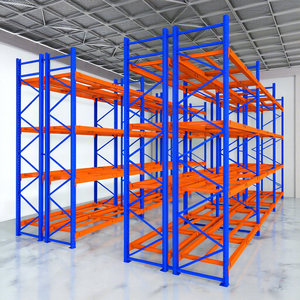
In modern supply chain management, optimizing floor space while maintaining operational velocity is a primary structural challenge. Push Back Racking Systems represent the pinnacle of dynamic Last-In, First-Out (LIFO) high-density pallet storage. Unlike standard selective racking which requires dedicated aisles for every pallet position, push back racking utilizes inclined structural rails and a series of nested, wheeled carts.
The kinematic operational flow relies on gravity and forklift propulsion. When a forklift operator places the first pallet into a lane, it rests on the top cart. When loading the second pallet, the driver gently pushes the first pallet back into the rack lane, revealing the second cart beneath it. This process can be extended up to 6 pallets deep per lane level. Upon picking, gravity naturally glides the remaining pallets forward to the aisle face at a controlled speed, presenting the next pallet for seamless retrieval.
Kinetic Energy Control
Precision-engineered rail slopes (1.5° to 2.5° pitch) prevent acceleration runaway, guaranteeing smooth gravity flow across varying pallet load weights.
Nested Cart Design
Low-profile, heavy-gauge steel carts nest compactly inside one another, preserving valuable vertical bay clear height for forklift masts.
Safety Interlocks
Integrated anti-lift tabs and mechanical end-stops prevent cart derailment during aggressive loading or accidental forklift impact.
2. Technical Specifications & Structural Material Benchmarking
As a primary original equipment manufacturer (OEM) and global exporter, structural integrity is engineered at the metallurgical level. Our factories utilize high-tensile cold-rolled steel (Q235B and Q355B grades) conforming to international stress-strain standards. Structural structural I-beams or heavy-gauge roll-formed upright profiles are chosen depending on seismic zone demands and severe impact conditions.
| Engineering Parameter | Roll-Formed OEM Configuration | Structural Steel (I-Beam) OEM Configuration |
|---|---|---|
| Steel Grade & Yield Strength | Q235B Cold-Rolled Steel (Fy = 235 MPa) | Q355B / ASTM A572 Grade 50 (Fy = 355 MPa) |
| Cart Load Capacity (Per Level) | Up to 1,000 kg (2,200 lbs) | Up to 1,500 kg+ (3,300 lbs) Heavy-Duty |
| Storage Depth (Pallet Positions) | 2-Deep to 4-Deep Lanes | 2-Deep to 6-Deep High-Density Lanes |
| Temperature Range Compatibility | -10°C to +45°C Standard Logistics | -30°C to +50°C Cold Chain & Blast Freezers |
| Finish Options | Electrostatic Epoxy Powder Coating (60-80μm) | Hot-Dip Galvanized (HDG) / Architectural Powder Coating |
| Seismic Compliance Standard | RMI / ANSI MH16.1, FEM 10.2.02 | INPRES-CIRSOC 103, EN 15512, RMI Seismic Zones 1-4 |
3. Industrial Application Profiles & ROI Analysis
Push back rack systems deliver the highest return on investment (ROI) in facilities where floor space comes at a premium cost per square meter. By converting aisle footprint into operational storage bays, organizations increase volumetric storage utilization by 75% to 90% over standard selective racking layouts.
Refrigerated & Frozen Storage
Refrigeration energy is an ongoing operational expenditure. Push back systems minimize unused air cube volume in freezer vaults (-25°C), reducing thermal dissipation and utility overheads.
High-Turnover Batch Goods
Ideal for storing multiple SKUs with multiple pallets per SKU. Each lane acts as a dedicated batch location, streamlining put-away and picking cycles without driving into the rack structure.
3PL & Cross-Docking Facilities
Reduces forklift travel distances and vehicle wear-and-tear. Operators pick and deposit strictly at the front aisle face, reducing cycle times by up to 40% compared to Drive-In systems.
Custom OEM Customization Engineering Options
Because standard off-the-shelf racking rarely aligns with complex building column grids, sprinkler clear spaces, or custom pallet footings, our OEM manufacturing facilities deliver complete tailored engineering:
- Pallet Footprint Adaptability: Engineered for ARLOG (1000 x 1200 mm), Euro (800 x 1200 mm), GMA (40 x 48 inch), and industrial non-standard steel or plastic skid bases.
- Wheel Bearing Engineering: Sealed precision steel bearings with low-temperature synthetic lubricants prevent freezing lockups inside deep freeze environments.
- Custom Cart Color Coding: Color-coded carts provide immediate visual cues to forklift operators regarding lane depth status and remaining capacity.
- Integrated Column Protection: Reinforced bottom upright guards, heavy-duty floor-anchored bull-nose protectors, and structural aisle shielding against forklift mast strikes.
4. Global Procurement & Industry Trends (2025–2030)
The material handling industry is undergoing a structural transition toward hybrid automation and smart warehousing. As a forward-thinking exporter, our factory R&D focuses on integrating push back mechanical reliability with digital supply chain ecosystems:
IoT Load & Strain Monitoring
Embedding smart load sensors within structural beam connections to report real-time bay utilization, operational stress overload warnings, and automated structural deflection alerts to WMS platforms.
AGV & AMR Compatibility
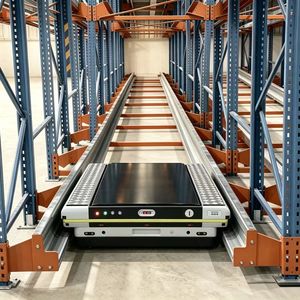
Redesigning cart front capture plates and guiding rails to match Autonomous Guided Vehicles (AGVs) and Autonomous Mobile Robots (AMRs) for unassisted automated pallet loading.
Sustainable Green Steel Sourcing
Transitioning manufacturing production lines to zero-emissions electric arc furnace (EAF) steel, offering certified low-carbon rack structures to assist global enterprise ESG commitments.
5. Quality Assurance, Factory Manufacturing & Exporter Advantages
Direct factory sourcing eliminates redundant intermediary margins while guaranteeing end-to-end quality supervision. Our manufacturing facilities are equipped with automated CNC roll-forming lines, robotic welding stations, and fully continuous electrostatic powder-coating tunnels.
Every export batch undergoes rigorous quality control checks prior to container loading:
- Non-Destructive Testing (NDT): Ultrasonic and magnetic particle weld testing on structural beam connectors and heavy cart frames.
- Full Load Testing: In-house structural rack bay load testing replicating 150% rated design limit to measure beam deflection tolerances (L/180 standard).
- Export Packaging Integrity: Steel strapping, protective corner guards, moisture-barrier wrapping, and custom wooden cradles for ocean freight container transport.
6. Frequently Asked Questions (FAQ) for Storage Directors
Request a Custom OEM Engineering & Factory Quote
Connect directly with our senior structural design team. Send us your warehouse floor plan, pallet dimensions, and storage targets for a complimentary CAD layout and structural proposal.
Contact Us