Industrial Storage & Longspan Racking Portfolio
Explore our CE-certified high-density shelving and heavy-duty structural racking units, designed for optimal volumetric efficiency and safe operational loads.
Engineering Excellence: Structural Integrity & Manufacturing Mastery
In the context of modern industrial logistics and intra-facility supply chain management, selecting certified industrial longspan shelving systems represents a critical intersection between operational efficiency, dynamic structural safety, and life-cycle asset management. As a leading CE Certified Longspan Shelving Manufacturer & Factory, our engineering architecture is anchored in rigid finite element analysis (FEA), strict compliance with European Norms (EN 15512, EN 15620, EN 15629, and EN 15635), and advanced robotic metallurgical processing.
Factory Capabilities & Production Standards
Our manufacturing complex spans over 65,000 square meters of automated production infrastructure. Driven by Industry 4.0 principles, our production lines integrate automated roll-forming machines capable of continuously profiling upright frames with variable pitch patterns (50mm, 75mm, and 76.2mm adjustments) without compromising structural cold-work hardness.
High-Precision Roll Forming
Continuous automated profiling ensures dimensional tolerance within ±0.2mm on post uprights and Z-beam profiles, guaranteeing uniform load distribution across multi-bay configurations.
Robotic Welding & Locking Clips
Robotic MIG/MAG welding guarantees deep penetration at beam-to-connector joints. Integrated safety locking pins prevent accidental beam dislodgement under high forklift activity.
Thermohardening Epoxy Coating
Fully automated 7-stage pre-treatment and degreasing combined with electrostatic epoxy-polyester powder coating (60-80μm thickness) tested under ASTM B117 salt spray environments.
Structural Engineering Specifications & Dynamic Matrix
Understanding the operational parameters of longspan shelving versus conventional pallet racking and cantilever systems is essential for logistics architects and procurement managers. The selection depends on handling medium (hand-picked items, boxed inventory, non-standard long items, or heavy palletized loads) and target storage density.
| Storage System Category | Primary Load Type | Load Capacity Range | Standard Structural Profile | Primary Design Standard |
|---|---|---|---|---|
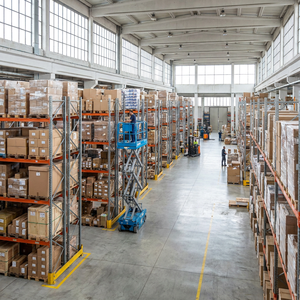
| Industrial Longspan Shelving | Medium-to-Heavy Hand Pick / Cartons | 300 kg – 1,000 kg / level | Step Beams / Z-Beams & Upright Frames | FEM 10.2.02 / EN 15512 |
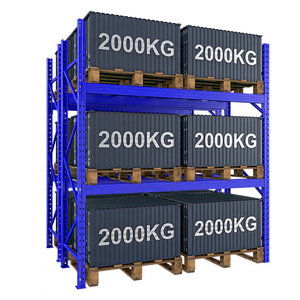
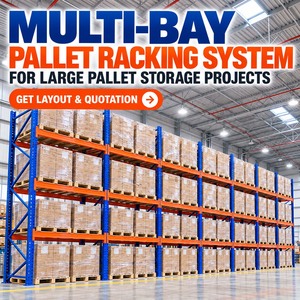
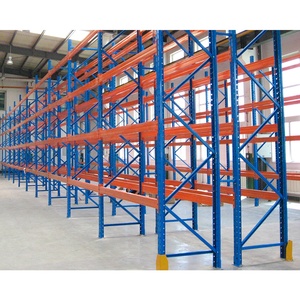
| Heavy-Duty Pallet Racks | Unit-Load Pallets (Forklift Handling) | 1,000 kg – 4,500 kg / level | Box Beams & Heavy C-Section Posts | EN 15512 / ANSI MH16.1 |
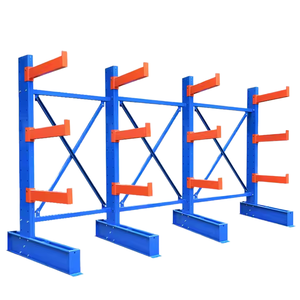
| Heavy Duty Cantilever Racks | Long Pipes, Lumber, Steel Profiles | 500 kg – 3,000 kg / arm | Telescopic/Solid Columns & Pivot Arms | FEM 10.2.09 / BS 5950-5 |
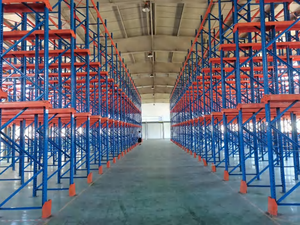
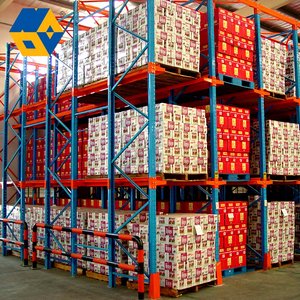
| High-Density Drive-In Racks | Homogeneous Bulk Pallets (LIFO) | 1,000 kg – 1,500 kg / position | Cold-Formed Continuous Support Rails | EN 15620 / RMI Guidelines |
Strategic Global Procurement Trends (2025–2030)
The global industrial warehousing landscape is undergoing a paradigm shift driven by e-commerce expansion, omnichannel fulfillment centers, and localized micro-fulfillment hubs. Procurement strategies for structural steel racking and longspan shelving are moving away from mere low-cost sourcing toward risk-mitigated, highly adaptable, and environmentally compliant equipment procurement.
1. Dynamic Modular Adaptability & Rapid Assembly Architecture
Modern distribution centers demand rapid re-configuration capability without structural modification or floor re-drilling. Advanced longspan shelving systems are now designed with boltless drop-in beam connectors that utilize gravity-lock wedge geometry. This allows warehouse operators to reconfigure shelf heights at 50mm increments in response to changing SKU dimensional velocity profiles, reducing maintenance downtime by over 65% compared to legacy bolted shelf systems.
2. Total Cost of Ownership (TCO) over Initial CAPEX
Leading global buyers are shifting focus from initial purchase price (CAPEX) to TCO models. Factors influencing this trend include structural repair kits, corrosion-resistant powder coatings, and seismic hazard compliance (e.g., INPRES-CIRSOC 103 or US RMI seismic zones). Investing in high-grade Q355B cold-rolled steel with certified fatigue thresholds reduces rack deformation risks caused by impact, lowering long-term insurance premiums and structural audit expenses.
3. ESG Alignment and Low-Carbon Steel Supply Chains
With corporate sustainability mandates accelerating across Europe and North America, buyers require documentation verifying the carbon intensity of structural steel production. As a forward-thinking factory, our manufacturing processes incorporate recycled steel scrap inputs (up to 35%), eco-friendly solvent-free powder coatings, and closed-loop water reclamation systems during pre-treatment, supporting scope 3 emissions reductions for enterprise clients.
Industrial Development Trends in High-Density Storage Engineering
As warehouse real estate costs continue to rise globally, maximizing cubic volume utilization (the "Cube") rather than floor area (square footage) has become an engineering imperative. Longspan shelving is evolving from standalone static racks into integral components of complex automation ecosystems.
Integration with Autonomous Mobile Robots (AMRs) and Goods-to-Person (G2P) Systems
The convergence of longspan shelving structures with AMR fleets requires tighter manufacturing tolerances. Rack bases, beam horizontal deflections, and aisle clearances must align strictly with optical sensor tolerances and automated lift mechanisms. Standard allowable beam deflection limits of $L/200$ under full static load are frequently tightened to $L/300$ or $L/400$ for automated robot interaction, ensuring seamless picking operations without mechanical jam hazards.
Multi-Tier Pick Module Infrastructure
Industrial longspan shelving is increasingly serving as the core structural framework for multi-tier mezzanine pick modules. By stacking 2 to 4 levels of longspan walkways vertically, facilities can triple or quadruple their available picking surface area within the same physical footprint. These installations require structural integration with floor grating, staircases, anti-collapse wire mesh decking, and integrated sprinkler pipe conduits engineered under strict EN 12845 fire protection standards.
Enterprise Strengths: Why Partner with Our CE Certified Factory
Navigating global supply chains requires a reliable manufacturing partner capable of delivering consistent metallurgical quality, robust engineering support, and transparent international compliance verification.
End-to-End FEA Calculation & Rigor
Every longspan project undergoes custom structural calculation using software verified against EN 15512 standard algorithms. We provide certified load capacity plates and structural calculation reports signed by certified structural engineers for every customized layout.
Certified Metallurgical Traceability
We source raw steel coils exclusively from tier-one steel mills. Every production batch is accompanied by Mill Test Certificates (MTC) conforming to EN 10204 3.1, detailing yield strength, tensile stress, percentage elongation, and chemical composition analysis.
Comprehensive Turnkey Engineering
From initial DWG/BIM layout design and seismic ground-motion hazard assessment to custom packaging, container loading optimization, and remote/onsite installation supervision, our engineering team manages the entire project lifecycle.
Frequently Asked Questions (Procurement & Engineering FAQ)
CE Certification for longspan shelving and industrial steel racking primarily relies on European standard compliance frameworks: EN 15512 (Steel static storage systems - Adjustable pallet racking systems - Principles for structural design), EN 15620 (Tolerances, deformations and clearances), EN 15629 (Specification of storage equipment), and EN 15635 (Application and maintenance of storage equipment). CE marking ensures mechanical load safety, structural stability, non-hazardous surface materials, and strict quality control during manufacturing.
Under standard FEM 10.2.02 and EN 15512 specifications, the maximum allowable vertical deflection ($\delta$) of a shelf beam or longspan step beam is $L/200$, where $L$ is the clear span length of the beam. For example, a 2,000mm long beam under maximum rated safe working load (SWL) should not deflect vertically by more than 10mm. For automated AMR picking or specialized electronic storage applications, custom deflection constraints of $L/300$ or $L/400$ can be engineered upon request.
Q235B steel offers a minimum yield strength ($f_y$) of 235 MPa, making it cost-effective for standard longspan shelf beams and light-to-medium-duty uprights. Q355B steel provides a minimum yield strength of 355 MPa (over 50% stronger in plastic deformation resistance). Utilizing Q355B for upright frames allows for thinner wall profiles while achieving higher load-bearing capacity, reducing overall structural weight, optimizing shipping costs, and improving seismic energy absorption performance.
Yes. Custom seismic engineering involves conducting dynamic response spectrum analysis according to local codes (e.g., Eurocode 8, US RMI, or Argentina INPRES-CIRSOC 103). For high-hazard seismic zones, we engineer widened floor base plates, heavy-duty floor anchor bolts (chemical or expansion anchors rated for cracked concrete), specialized diagonal frame bracing arrays, and elevated safety factors on beam connector welds to resist cyclic lateral shear loads.
We provide four primary decking configurations depending on operational requirements: (1) Drop-in Galvanized or Powder-Coated Steel Panels for maximum durability and fire resistance; (2) High-Density Particle Board / Moisture-Resistant MDF for cost-effective dry goods hand picking; (3) Open Wire Mesh Decking for enhanced sprinkler water penetration, light passage, and dust prevention in compliance with NFPA 13 rules; (4) Flame-Retardant Solid Plastic Decking for cleanroom or pharmaceutical environments.
Our continuous automated surface treatment line utilizes a 7-stage pre-treatment process: Alkaline Degreasing -> Rinsing -> Surface Conditioning -> Zinc Phosphating -> Neutralization -> Deionized Water Rinsing -> Drying Oven. Powder application uses thermosetting epoxy-polyester powder applied electrostatically and cured at 180°C to 200°C. Quality control includes cross-hatch tape adhesion tests (ISO 2409 Class 0), impact resistance testing (ASTM D2794), and neutral salt spray testing (ISO 9227) up to 500 hours without red rust initiation.
Ready to Optimize Your Warehouse Infrastructure?
Consult with our senior structural engineering team today for custom layout designs, load calculations, finite element analysis reports, and competitive direct-from-factory pricing.
Inquire Now