Engineering Whitepaper: Structural Integrity and Load Optimization in Modern Industrial Rack Storage
As global supply chains transition toward higher vertical clearance warehouses and automated material handling environments, the structural stability, load-bearing reliability, and safety compliance of industrial rack storage systems have become crucial operational parameters. Industrial pallet racking is no longer viewed as static steel shelving; it is an engineered structural system subject to dynamic live loads, forklift impact forces, sway vibrations, and potential seismic accelerations. Selecting a certified industrial rack storage factory and exporter ensures that warehouse infrastructure strictly adheres to international structural safety codes, notably European Standard EN 15512:2020, FEM 10.2.02, and American RMI ANSI MH16.1 specs.
Technical Insight: Structural safety in high-bay pallet racking relies on maintaining strict sway displacement limits (typically $L/200$ under full design load) while preserving a minimum 1.95 safety factor against ultimate yield strength under combined axial compression and bending moments.
1. Metallurgy and Cold-Formed Steel Profiling Excellence
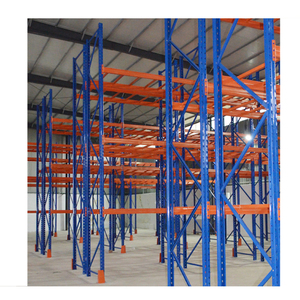
The core load-bearing capability of heavy-duty selective pallet racking, cantilever racks, and narrow aisle storage systems depends fundamentally on raw material selection and cold-formed profile geometry. Premium racking manufacturing utilizes high-tensile structural steel grades, predominantly Q235B and Q355B (equivalent to European S235JR and S355JR under EN 10025 standards).
To maximize the moment of inertia without introducing excessive tare weight, upright frames feature multi-fold column cross-sections—typically 8 to 12 cold-rolled folds. These structural folds significantly mitigate localized buckling under intense axial compression. Box beams and step beams are formed by continuously welding two interlocking C-sections or roll-forming closed structural profiles with drop-forged connector jaws. The connector jaws incorporate multi-claw locking pins (often 3 to 5 teeth per connector) fitted with spring-loaded mechanical safety locks to prevent accidental beam displacement caused by upward forklift mast snagging.
2. Structural Compliance: EN 15512 vs. RMI ANSI MH16.1 Specifications
Global procurement teams must carefully verify structural engineering certifications. A CE-marked industrial racking facility demonstrates compliance with the European Construction Products Regulation (CPR) and safety frameworks outlined in standard EN 15512. The structural design methodologies between European (FEM/EN) and North American (RMI) standards share fundamental safety goals but differ in partial load safety factors and finite element simulation constraints:
- European EN 15512: Utilizes limit state design (LSD) with specific partial safety factors applied to dead loads ($\gamma_G = 1.35$), live pallet loads ($\gamma_Q = 1.40$), and material yield resistance ($\gamma_M$). It strictly mandates global frame sway analysis considering initial imperfections and frame connection rotational stiffness ($C_{i,d}$).
- American RMI (ANSI MH16.1): Employs either Load and Resistance Factor Design (LRFD) or Allowable Stress Design (ASD). It requires explicit evaluation of baseplate anchor tension and shear interaction under overturning moments induced by top-tier loading and seismic shear forces.
Global Industrial Racking Procurement & Future Sourcing Trends (2025–2030)
The industrial warehouse storage sector is undergoing a rapid evolution driven by e-commerce expansion, omnichannel logistics, cold-chain automation, and escalating industrial real estate costs. Procuring industrial storage equipment from established export factories requires understanding four strategic procurement macro-trends shaping global supply chains:
Trend 1: Hybrid High-Density and Automation-Ready Rack Frameworks
Modern distribution centers are moving away from traditional pure-selective rack setups toward hybrid high-density configurations. Facilities are increasingly integrating standard selective pallet bays with Very Narrow Aisle (VNA) systems, Push-Back Cart Systems, Pallet Flow Lanes, and automated shuttle systems (AS/RS). Modern racking structures must be manufactured with extreme dimensional tolerances ($\pm 1.0\text{ mm}$ over total frame height) to accommodate automated guided vehicles (AGVs) and autonomous mobile robots (AMRs) that rely on laser sensors and exact rack geometry.
Trend 2: Rigorous Seismic Awareness and Site-Specific Structural Engineering
Logistics operators expanding into seismic-active zones—such as the Latin American Andes, the Pacific Rim, or Southern Europe—require customized seismic racking engineering. Industrial rack exporters must provide complete site-specific calculation packages. This includes checking baseplate thickness (often elevated to 10mm–16mm gauge structural steel), installing heavy-duty double-anchor bolts per upright leg, and introducing longitudinal and transverse X-bracing bays designed in accordance with regional seismic codes (such as INPRES-CIRSOC 103 or US IBC/SEI 7 standards).
Trend 3: Environmental Sustainability and Decarbonized Steel Production
Enterprise procurement divisions now routinely evaluate scope 3 carbon emissions when selecting structural steel suppliers. Top-tier CE certified racking factories are adopting energy-efficient closed-loop electrostatic powder-coating systems that completely eliminate volatile organic compounds (VOCs). Furthermore, factories sourcing green steel produced via electric arc furnaces (EAF) utilizing recycled scrap steel offer significant lifecycle carbon footprint reductions for green building initiatives (such as LEED or BREEAM certification).
Trend 4: Modular Upright Protection and Reduced Total Cost of Ownership (TCO)
Warehouse managers recognize that initial capital expenditure (CapEx) accounts for only a portion of lifetime storage assets. Upright frame damage resulting from material handling equipment (MHE) collisions is the primary driver of warehouse maintenance downtime. Advanced factory exporters now design integrated straddle column protectors, heavy-duty rubber-cushioned steel bumpers, and bolt-on engineered rack repair kits. These allow damaged lower column sections to be replaced rapidly without requiring complete teardown of fully loaded multi-tier bays.
Industrial Storage Racking Technical Comparison Matrix
The comparative data visualization table below outlines standard technical parameters, operational density metrics, and structural characteristics across primary industrial rack storage configurations:
| Storage System Type | Selectivity (%) | Footprint Density | Standard Load Capacity / Level | Ideal Inventory Rotation | Handling Equipment Compatibility |
|---|---|---|---|---|---|
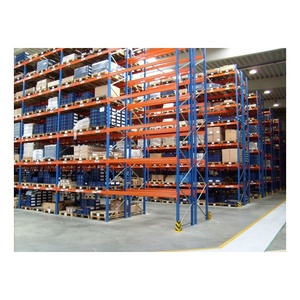
| Selective Pallet Racking | 100% | Standard (35%–40% Cube) | 1,000 kg – 4,500 kg | FIFO (First-In, First-Out) | Standard Counterbalance, Reach Trucks |
| Very Narrow Aisle (VNA) | 100% | High (55%–65% Cube) | 1,000 kg – 3,500 kg | FIFO | VNA Man-Up Turret Trucks, AGVs |
| Drive-In / Drive-Thru Rack | 15%–20% | Very High (65%–75% Cube) | 800 kg – 2,000 kg / pallet position | LIFO (Drive-In) / FIFO (Drive-Thru) | Specialized Narrow Counterbalance Trucks |
| Push-Back Cart Racking | 25%–30% | High (55%–65% Cube) | 1,000 kg – 2,500 kg / cart lane | LIFO (2 to 6 Pallets Deep) | Standard Reach & Counterbalance Trucks |
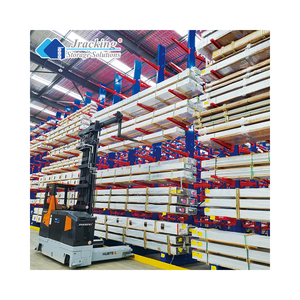
| Heavy-Duty Cantilever Rack | 100% (Long Goods) | Variable / Structural | 500 kg – 3,000 kg / arm | Any (Unobstructed Front) | Side Loaders, Multi-Directional Forklifts |
| Multi-Level Pick Modules | 100% (Case/Item) | Maximized Vertical Volumetric | 300 kg – 1,000 kg / shelf layer | FIFO / Dynamic Batch Picking | Conveyor Integration, Manual Order Pickers |
Enterprise Factory Infrastructure and Manufacturing Excellence
As an established CE certified industrial rack storage manufacturer and international exporter, our manufacturing infrastructure combines automated precision machinery with rigorous quality assurance protocols. Our production floor operates multiple automated continuous cold-roll forming production lines capable of precision punching on 50mm, 52mm, 75mm, and 76.2mm (3-inch) pitch centers.
Robotic Laser Cutting and Automated Weld Fabrication
Connector beam jaws, heavy baseplates, and structural portal bracing components are processed using multi-axis CNC fiber laser cutting systems, ensuring structural hole alignment tolerances within $\pm 0.1\text{ mm}$. Structural welding of beam connectors and column base assemblies is performed by robotic MIG/MAG welding stations equipped with continuous wire feed and argon-shielded gas controls. Every weld batch undergoes routine non-destructive testing (NDT), including visual weld throat measurement, magnetic particle inspection (MPI), and ultrasonic testing (UT) on heavy structural cantilever arms.
Surface Pre-treatment and Quality Verification Standards
Before entering the automated electrostatic powder coating tunnel, all steel components pass through a 4-stage automated pre-treatment line: degreasing, acid rust removal, zinc-iron phosphating, and deionized water rinsing. This rigorous surface preparation ensures salt spray corrosion resistance exceeding 500 hours (ASTM B117 standard). Every export order is issued a comprehensive quality documentation package, including EN 10204 3.1 Mill Test Certificates verifying raw steel chemical composition and tensile strength, CE Declarations of Performance (DoP), and full loading capacity charts signed by structural engineering experts.