Featured Industrial Pallet Racking Systems
Direct factory engineered structural steel rack solutions certified for heavy-duty industrial storage, seismic safety, and automated logistics.
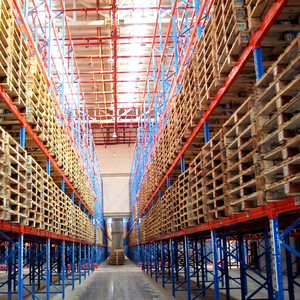
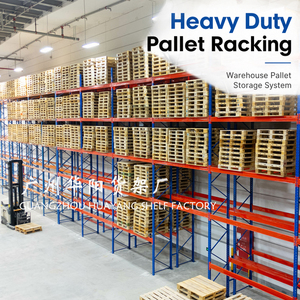
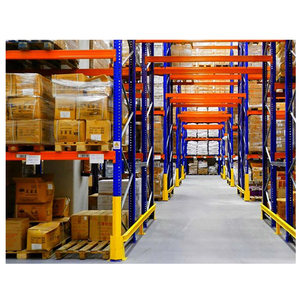
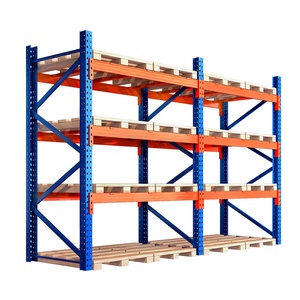
Engineering Rigor & Strategic Compliance: The CE Certified Racking White Paper
An authoritative analysis of structural integrity, finite element calculations, and safety standard benchmarks in global warehouse infrastructure.
In modern industrial logistics, static storage equipment is no longer evaluated simply as inert steel fabrications. Industrial pallet racking systems represent load-bearing, dynamic structural matrices subject to multi-directional stress vectors, seismic accelerations, localized impact forces from Material Handling Equipment (MHE), and sustained creep deflection. Selecting a certified manufacturer for **CE Certified Industrial Pallet Racking Systems** is the foundational requirement for legal compliance, asset protection, and operational continuity across international distribution channels.
1. Structural Metallurgy and Load-Bearing Mechanics
The structural load envelope of an industrial racking upright or box beam depends intrinsically on material yield stress ($f_y$) and ultimate tensile strength ($f_u$). Our manufacturing facilities utilize hot-rolled and cold-formed high-tensile steel grades strictly conforming to S355JR / Q355B and S235JR / Q235B standards. By utilizing Q355B structural steel for vertical upright frames, the minimum yield strength is maintained at $\ge 355 \text{ N/mm}^2$, providing a 51% increase in yield resistance over conventional mild steel profiles.
Cold-forming profiles undergo continuous multi-station CNC precision roll-forming to create complex geometric profiles with continuous stiffening ribs. The insertion of localized stiffeners along the column profile flanges alters the effective width-to-thickness ratio, mitigating local elastic buckling and distortional buckling modes under extreme vertical compression.
Advanced Cold Roll Forming
Continuous 18-stage precision rolling lines guarantee uniform profile thickness, tight dimensional tolerances ($\pm 0.5\text{mm}$), and zero residual mechanical stress along profile radii.
Interlocking Beam Connectors
Heavy-duty 3, 4, or 5-hook connector claws cold-stamped from high-grade structural plate feature automatic safety locking pins resistant to vertical dislodgement forces exceeding $5.0 \text{ kN}$.
Seismic Zone Compliance
Custom structural design verified against INPRES-CIRSOC 103, Eurocode 8, and ANSI MH16.1 seismic displacement spectrums using dynamic response spectrum analysis.
2. Surface Treatment & Environmental Protection Metrics
To ensure long-term durability in ambient warehouses, cold-storage environments (-30°C), and coastal facilities, surface pre-treatment is rigorously executed across an automated multi-stage process:
- Alkaline Degreasing & Acid Pickling: Complete removal of surface oxides, mill scale, and residual lubricants.
- Zinc Phosphate Nanotechnology Pre-treatment: Enhances substrate bonding adhesion and prevents sub-film micro-corrosion.
- Electrostatic Powder Coating: Thermosetting epoxy-polyester powder applied at $60 - 80 \mu\text{m}$ dry film thickness (DFT), cured at 200°C for exceptional impact and chemical abrasion resistance.
- Hot-Dip Galvanizing (ISO 1461): For extreme humidity or outdoor installations, components receive zinc coatings exceeding $65 \mu\text{m}$ ($450 \text{ g/m}^2$), providing a 30+ year operational lifespan.
Technical Performance & System Selection Matrix
Direct comparison of certified industrial racking architectures to optimize volumetric storage density and operational throughput.
| Racking System Type | Storage Density Ratio | Pallet Selectivity | Typical Bay Load Range | Inventory Management | CE / Standard Certification |
|---|---|---|---|---|---|
| Selective Pallet Racking | Medium (60%) | 100% Direct Access | 1,000 kg – 4,500 kg / Level | FIFO (First-In, First-Out) | EN 15512 / FEM 10.2.02 / ANSI MH16.1 |
| Drive-In / Drive-Thru Rack | High (85%) | Low (20-30%) | 1,000 kg – 1,800 kg / Pallet | LIFO / FIFO Option | CE Mark / ISO 9001 / AS4084 |
| Push-Back Cart System | High (75%) | Lane Selective (40%) | 1,200 kg – 2,000 kg / Position | LIFO (2 to 6 Pallets Deep) | EN 15512 / CE Certified |
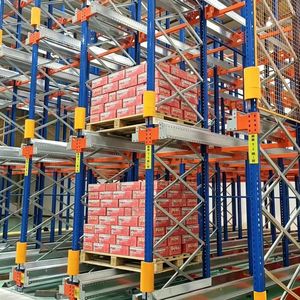
| Automated Radio Shuttle | Ultra-High (90%+) | Automated Lane Control | 1,500 kg / Pallet Position | Flexible FIFO / LIFO | CE / Direct Directive 2006/42/EC |
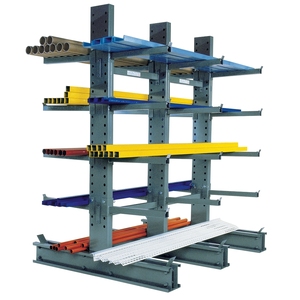
| Heavy-Duty Cantilever | Specialized | 100% Linear Access | 500 kg – 3,000 kg / Arm | Continuous Linear Storage | EN 1993-1-1 (Eurocode 3) / CE |
Optimize Your Facility Layout with Certified Structural Engineers
Receive a complimentary CAD floorplan layout design, load capacity calculations, and factory-direct export quotation within 24 hours.
Send an InquiryFuture Trends in Industrial Storage & Global Smart Procurement
How automation integration, structural IoT sensors, and green steel standards are reshaping the global procurement landscape for 2025 and beyond.
The global industrial warehousing sector is undergoing a structural paradigm shift driven by e-commerce fulfillment speed, skyrocketing land costs, and net-zero sustainability mandates. Enterprise procurement directors are shifting focus from simple unit cost purchasing to **Total Lifetime Structural Cost (TLSC)** and automated integration capability.
1. Integration of High-Density Automation (AS/RS & Shuttle Interfaces)
Traditional manual forklift racking is rapidly giving way to hybrid automated systems. Radio Shuttle Racking and Automated Storage and Retrieval Systems (AS/RS) require manufacturing tolerances far tighter than traditional static shelving. Where standard roll-forming allows beam sag of $L/200$, AS/RS racking profiles engineered for stacker cranes or autonomous mobile robots (AMRs) must maintain deflection limits strictly under $L/300$ to $L/400$, backed by millimeter-accurate structural plumbness tolerances enforced under **EN 15620 (Class 100 to 400)**.
2. Structural Health Monitoring (SHM) & Sensor-Embedded Rack Integrity
Next-generation CE certified racking installations are introducing IoT-enabled strain gauge sensors and micro-accelerometers embedded directly within vertical frame bases and lower beam levels. These telemetry nodes continuously track micro-deflections, unauthorized forklift impacts, and cumulative structural fatigue, communicating directly with Warehouse Management Systems (WMS). Real-time structural monitoring transitions facility maintenance from periodic manual audits to dynamic predictive safety management.
3. Decarbonization and Sustainable Green Steel Procurement
Global supply chains require documented Carbon Footprint Statements for building infrastructure. Leading pallet racking factories are transitioning towards Electric Arc Furnace (EAF) steel processing fueled by renewable energy, reducing embodied carbon dioxide equivalent ($\text{CO}_2\text{e}$) per ton of finished rack by up to 60% compared to traditional Blast Furnace-Basic Oxygen Furnace (BF-BOF) production. Compliance with ISO 14064 carbon verification is becoming a non-negotiable metric in international tier-1 project tenders.
EN 15635 Inspection Protocols
Standardized visual damage classifications (Green, Amber, Red hazard levels) built into design specifications to facilitate rapid facility safety sign-offs.
Modular Scalability
Teardrop and universal boltless hole patterns designed for rapid beam height adjustments at 50mm, 75mm, or 76.2mm pitch increments without structural dismantling.
Impact Defense Systems
Integrated heavy-gauge column protectors, rack end guards, and wrap-around polymer deflector boots designed to absorb kinetic impact energy up to 1,000 Joules.
Factory Direct Manufacturing Superiority & Global Logistics Capability
Why Tier-1 industrial buyers, EPC contractors, and global logistics operators partner directly with our manufacturing headquarters.
As a leading original equipment manufacturer (OEM) and global exporter specializing in high-capacity warehouse racking, our enterprise infrastructure bridges raw steel processing with customized structural engineering. Operating from state-of-the-art production complexes, we ensure end-to-end quality control across every phase of production.
1. Advanced Manufacturing Equipment & Robotic Automation
Our production floors integrate fully automated manufacturing cells designed to eliminate human error and dimensional variance:
- CNC Automated Punching Lines: High-speed hydraulic gang punching machines process upright cold-formed strip steel with hole position accuracy of $\pm 0.1\text{mm}$ over 12-meter continuous frame lengths.
- Robotic Welding Workstations: Japanese Panasonic twin-arm robotic welding systems execute continuous fillet welds on beam end connectors, guaranteeing flawless penetration depth, zero porosity, and uniform stress distribution.
- Automated Powder Coating Lines: Dual Swiss Gema powder coating booths featuring 16 automatic spray guns ensure uniform coating thickness even within complex profile channels and internal flange geometries.
2. Strict Quality Control & International Testing Protocols
Quality assurance is embedded at every manufacturing node. Raw material coils are tested for chemical composition via spectrographic analysis and subjected to tensile yield testing prior to uncoiling. Finished structural bays undergo destructive weld shear testing, beam load deflection verification under hydraulic testing rigs, and salt spray fog testing (ASTM B117) exceeding 500 hours without red rust initiation.
Industrial Racking Procurement FAQ
Detailed technical and operational answers to common questions raised by warehouse logistics managers, civil engineers, and international procurement specialists.
Partner with a Direct Factory Exporter for Your Next Racking Project
Contact our engineering sales director today to submit your warehouse floorplan or project specification RFQ for instant technical evaluation.
Send an Inquiry